Saturday, August 29, 2009

Short book review: "Haunted" by Kelley Armstrong

The premise of this book is interesting, as the main character is Savannah's dead mother, Eve. At the end of the last book, she made a deal to owe the Fates a favor in exchange for helping Paige, and in this book they call in the favor. Eve is sent into a hell dimension to track a chaos-causing spirit called a Nix, which possesses human beings and helps them commit horrible crimes. In a neat bit of historical inclusion, one of the Nix's victims was Lizzie Borden.

To trace the spirit, Eve moves through a bunch of different levels of the afterlife, sometimes alone and sometimes with the help of Kristoff Nash, Savannah's also-dead sorcerer father. While tracking the Nix, Eve also works through her obsession with watching her daughter and also her strange relationship with Kristoff--so in addition to the adventure/horror/supernatural aspect of the story, there's also a dose of romance.

I liked the book, though not as much as the one right before or after it in the series.

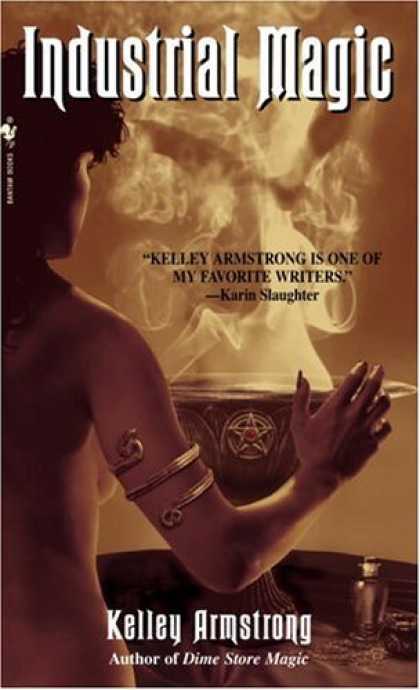
Short book review: "Industrial Magic" by Kelley Armstrong

I put off reading this one for a while, since Dime Store Magic didn't really thrill me. Once I started it, I was pleasantly surprised. Paige, Savannah, and Paige's Cabal sorcerer boyfriend Lucas have moved to Oregon and are living happily. Then Lucas' father shows up, wanting them to help the sorcerer Cabals with attacks on a number of their employees' teenaged children. At first they resist, thinking it's another ploy for the elder Cortez to lure his wayward son back to the fold, but eventually they agree to help.

I really liked this particular book; this was the first one in the series I had a hard time putting down. It was also a nice bridge to the next book: in addition to Lucas and Paige, we see the werewolf pack again, and the necromancer Jamie Vegas. Savannah's ghostly mother is part of the story too, which leads to the next book--which I rushed to read after this one. Becoming one of my favorite series.

Short book review: "Dime Store Magic" by Kelley Armstrong.

I'm way behind on my reviews; I've got a big list, but some of them I read months ago and have forgotten some of the finer details. So I'm going to do really short reviews.

Dime Store Magic follows the witch named Paige that we met at the end of the second book, as she struggles to raise Savannah, the daughter of a black witch who was kidnapped and killed. It didn't really hold my attention, and took me a while to get through it--partially because Paige's whining about her body issues pissed me off, and partially because she just seemed like such a weak, wishy-washy character the entire time. She also does some blatantly stupid things, like walking in to obvious traps.

It's not a terrible book; and we do get some story development. I recommend it as part of the series, but it's not the best.

Saturday, August 8, 2009

Things I'll eventually review.

Dime Store Magic, Industrial Magic, Haunted, and Broken by Kelley Armstrong.
The rest of the Anita Blake series.
The Merry Gentry series.
Night Shift by Lilith Saintcrow.
Magic Bites by Ilona Andrews.
Eleanor of Aquitaine and The Lady Elizabeth by Alison Weir.
1215 The Year of Magna Carta by ... people whose names I don't remember right now.

I think there's more but I forget.

Friday, July 17, 2009

Harry Potter and the Half-Blood Prince review number 87,353,343

Okay, so 87 million might be an exaggeration, but not by much. But I'm going to toss my opinion out there anyway!

I'm not going to shy away from spoilers, since I'm assuming most people know how things end. You've been warned! If you don't know what happens at the end of the story, don't read this review.

To give a little context: I've read all the books, and see all the movies. My favorite out of all the movies is the third--I'm not a huge fan of the first two. This is partially because of the terrible acting and cheesiness (the end of the second one makes me cringe), and partially because it looked so different from how I pictured it. The first two were also so obviously kid-oriented; I think the latter ones do a much better job of balancing the humor and magic of the books with the darker aspects. So even though the last three movies haven't been as faithful to the books, I like them a lot better.

The movie hit all the important points for this particular storyline: Slughorn and his altered memory, the trips into the Pensieve, Malfoy's scheme with the vanishing cabinet. Harry finds the used potions book, and uses the sectumsempra spell; he accompanies Dumbledore to get the Horcrux, watches Snape's apparent betrayal, and discovers the Horcrux is a fake. Sometimes the ways we get there are different--most notably, we see Malfoy's experiments with the cabinet and can see all along what's coming, even though none of our main characters would have knowledge of it--but the main points are all there.

The side plotlines of the relationships were fiddled with; Ron and Lavendar are hilarious, but Harry and Hermione bonding over their unrequited love for Ginny and Ron was created out of whole cloth. Harry and Ginny's relationship is boiled down to one kiss, essentially, and that's about it. Tonks calls Remus "sweetheart" at one point, but other than that there's nothing about their relationship at all.

A couple of other scenes were added, particularly a scene Bellatrix and Fenrir Greyback show up at the Burrow and lure Harry out of the house. Although it didn't happen in the book, I thought it was a good addition--mostly because there was so little actual action in the book until the very end. The fact that the Weasley's house is torched is going to cause problems later, though, I think.

Speaking of problems ... I'm interested to see how the heck they arrange for Harry, Hermione and Ron to find the rest of the Horcruxes, considering 99% of Harry's conversations/Pensieve trips with Dumbledore were completely left out. We don't see young Tom Riddle visiting the old lady with the Hufflepuff cup, or his mother and her family in their squalid hut. There's also nothing about nonverbal spells, Bill and Fleur, the Dursley's, Kreacher or the house on Grimmauld Place. Sirius is mentioned once, in passing. I know a lot of things would have to be left out; it's a very long book. But I'm not sure how they're going to weave all the pieces together for Deathly Hallows.

My biggest problem with the movie, though, is that the end felt very, very rushed. There was no battle in Hogwarts; Harry's duel with Snape was all of two spells. Snape tells Harry he's the half-blood prince but not why--not that it seems important in the scope of the movie. Dumbledore's memorial service is completely left out, as is Harry's ending conversation with Ginny.

All of this isn't to say I dislike the movie; I thought it was pretty good. It was very visually interesting, and it was funny and suspenseful. I'm not just sure how they're going to bridge the gap between this movie and everything that happens in Deathly Hallows.

Oh, one last thing--Tom Felton, the guy who plays Draco, does a great job.

Thursday, June 4, 2009

First impressions book review: "Skin Trade" by Laurell K. Hamtilon (Anita Blake 17)

I've had the book for nine hours and I'm only 86 pages in. It's just not holding my attention, which is really unusual. Normally I'd be finished with it by now.

On the other hand, 86 pages in and no sex, which is an improvement--I think the first 86 pages of the last book were all sex.

Thursday, April 9, 2009

Book review: "The Constant Princess" by Phillipa Gregory

Having read several of Phillipa Gregory's Tudor romances before, I was kind of excited to read a new one. I loved The Other Boleyn Girl (though not the movie) and The Queen's Fool; I liked The Boleyn Inheritance. I really disliked The Virgin's Lover, though. Since I'd read her previous book, I knew that Gregory takes a lot of liberties with history, and I was prepared for that.

However, I found that The Constant Princess is similar to The Virgin's Lover: both take a well-known historical figure and turn her character completely upside down. In The Virgin's Lover it was Elizabeth I; in this book it was Katherine of Aragon, first wife of Henry VIII. Katherine was a Spanish princess, raised by a warrior queen and a scheming king who were waging a holy war against the Moors. She was betrothed at a very young age to Arthur, the oldest son of Henry VII, and was married to him at around fifteen. He died soon afterward, and seven years later she was re-married to his younger brother, Henry. For the rest of her life, Katherine maintained that her marriage to Arthur had never been consummated, and so her marriage to Henry was legal with or without a papal dispensation.

In this book, Gregory puts forth the idea that this was a great lie. Most of the book is taken up by Katherine describing Spain and contrasting it with England, either to herself or to Arthur during their brief marriage. The Katherine of this book was deeply in love with her husband, and he with her; but because she was painfully shy and raised in a very prim court, Arthur snuck in to her chamber, where they would spend the night talking about their plans for England and their pasts. Then Arthur contracted the mysterious sweating sickness and died--but on his deathbed, in Gregory's novel, he made Katherine promise to marry his brother so she could become queen and fulfill their grand designs for the country's future. Everything Katherine does after that, from fighting to marry Henry to having children, she does for Arthur.

Here's the problem: Katherine was a very staunch, very devout Catholic. Even if she was willing to commit the sin of lying, it's hard to believe she would lie about her marriage being consummated. It's not as simple as telling a lie about being a virgin; it's a lie about being within the "forbidden degrees of consanguinity" in relation to Henry. It would mean that she would be committing incest, basically. It would mean she was fornicating outside of marriage, because her marriage to Henry would be invalid. It would mean that her children would be bastards. It would be a lie of far-reaching consequences, and unless her religious devotion was a false front, telling such a lie would be out of character. So basically, this entire book is based upon a premise that seems incredibly unlikely.

The fact that Gregory completely created some details also makes it less agreeable. For instance, there's an entire plotline where Katherine miscarries her first child (true) and then spends another several months in seclusion because a court doctor told her she was carrying twins and one was still to be born (false). During this time Henry takes his first mistress (false--it was during Katherine's second pregnancy), a woman named Anne (false--it was Margaret Blount). Granted these are small details, and all historical fiction takes those sorts of liberties--but there was no reason for it, and it just adds another layer of falseness to this entire book.

It's also a strangely paced story. There's a lot of exposition as Katherine describes Spain, describes her mother, describes her journey to England; she and Arthur fall in love and talk; she tries to be all wily and worldly and schemes to marry Henry; she marries Henry, had a child that dies, gets upset by his first affair .... and then everything fast-forwards and Katherine walks in to the courtroom to make her famous plea to Henry when he's trying to nullify their marriage.

Overall, I just wasn't impressed with this book. It felt like an idle romantic daydream drawn long, followed by a quick rush to resolve the story. I didn't even fully read the second half of the book; I skimmed over drawn-out descriptions and angst diary-like pages. This book is definitely one to skip.

Friday, February 20, 2009

Book review: "Stolen" by Kelley Armstrong (Women of the Otherworld 2)

Warning: contains spoilers for the previous book in the series.

Stolen is the second book in the "Women of the Otherworld" series, and just like the first, it took me a while to read. Our main character is still Elena, the only female werewolf, who at the end of the first book stopped fighting her nature and returned to her pack--and to her husband whom she said she'd never forgive for making her a werewolf. The last book was all about a pack problem, but this one introduces other characters. Elena is investigating someone selling information that would prove the existence of werewolves, which of course is something the pack isn't down with.

It ends up being a trap of sorts, however; instead of information-selling sleezebags, Elena meets two witches, Ruth and Paige, who want to invite the wolves to join a supernatural council. They tell her that supernaturals of all sorts (witches, half-demons, shamans, etc.) are being kidnapped. Various snafus and problems arise with actual council meeting itself, and then, to absolutely nobody's surprise, Elena is abducted.

The rest of the book is about Elena's experience there and unraveling the mystery of who's in charge, what they're doing, and why. It's interesting, but it still took me a while to plow through it, and like the first book, I'm not entirely sure why. Elena was less annoying in this book, since she wasn't whining about how much she hated being a werewolf, so that was a plus.

This was a book that I would put down for days at a time, but then sometimes I'd hit a part of it where I couldn't put it down. I still recommend the series, although I've ambivalent about this book in particular.

Tuesday, February 17, 2009

TV review: Joss Whedon's "Dollhouse"

This is the third show this year I've started watching just because of a particular actor (the other two being Leverage and Trust Me); this is also the second show since Buffy I've started watching because of Eliza Dushku. Unfortunately, I have a bad feeling that Dollhouse might go the same way as Tru Calling thanks to the ass clowns at Fox.

(I mean, seriously--they keep bullcrap like The Sarah Connor Chronicles and axe interesting shows like New Amsterdam? Futurama? Firefly? Arrested Development? Titus? I guess I should just be grateful they haven't axed my most beloved House. Or Bones. I would cry.)

Anyway.

Dollhouse opens with Eliza Dushku's unnamed character agitatedly talking with a calm, sort of generically sophisticated woman. We don't hear names, or really find out what's happened; but the gist of it is that Eliza's done something bad, something for which there are consequences, and the other woman is blackmailing her--or in her words, offering her a "clean slate".

Suddenly, cut to a two-person motorcycle race through city streets. Huh? Oh, there's her ass in leather--that explains the need for this sequence. It ends in a restaurant--literally, motorcycles in the building--and Eliza starts playfully flirting/accusing her racing partner of cheating. They go to dance, and we get another cheap cash-in on Eliza's looks: several minutes of her dancing in a white dress so short you get glimpses of buttcheek.

Eliza suddenly gets a vacant look on her face and wanders out on to the street to a van, where a man asks if she's ready for her "treatment". She hops in and off they go. The guy she left behind watches and makes a cryptic comment to his friend about Cinderella leaving before her coach turns in to a pumpkin--whatever's going on, he apparently knows about it.

We now learn that her name is "Echo", as she prattles on about her date and her weekend with the aforementioned guy. Everybody around her plays along, until she sits down in typical-looking mind control device, where blue lights flash around her head and she seems to be in pain. We see a quick rewind of the dancing, the racing, and things before all the way back to a mother figure above a crib. Echo opens her eyes and innocently asks if she fell asleep before sort of vaguely wandering off--a good bit of acting on Eliza Dushku's part.

The man who delivered her for "treatment" and the one who administered it talk briefly, and we learn that Echo's "imprint" has been erased, and that she doesn't remember anything ... and that all this is illegal.

And that's all before the opening credits roll.

I really want to like this show, because I think Joss Whedon is great and I love Eliza Dushku. And I do think it's interesting, although the premier was really heavy-handed--in addition to laying down the basics of "evil group wiping the minds of beautiful young women (and men, it's implied) to make money and MIND CONTROL OMG", they introduce an FBI agent searching for the "Dollhouse", and they allude to a rogue "active" like Echo. Oh, and they hint that Echo is remembering things despite her imprints being wiped, and they send her on a kidnap negotiation mission that's complicated enough on its own. I think if they left out of FBI agent and the rogue active, it wouldn't have been so overwhelming.

Like all Joss Whedon's shows, Dollhouse has a particular look and atmosphere. It's certainly got its share of creepy moments, and obviously is going to be a great platform for a couple of things: Eliza Dushku looking hot and kicking ass in various guises, and the sort of social/human nature commentary Buffy and Angel and everything else Whedon is known for. It'll be interesting to see if a good balance can be struck between those two things.

Although Fox's marketing of the show makes me think it's going to learn toward the sexual, cheap thrills side. I really could've done without the "OMG, look how sexy and amazing we are" interludes with Dushku and Summer Glau. I know sex sells, but I hope this show is given a chance to expand beyond that. I'll keep watching and see how it goes. I'll also keep watching for more familiar faces--it was nice to see Amy Acker again!

Wednesday, February 11, 2009

Book review: "The Dream-Hunter" by Sherrilyn Kenyon

A friend at work recommended Kenyon's books to me; she'd described the Dark-Hunter series as being about vampire killers, etc., and I added them to my Booksfree list just out of curiosity. I didn't realize until I received The Dream-Hunter, and read the back, that it's part of a genre I eschew: romance. (pause for Wilhelm scream) Still, I gave it a try on my friend's recommendation. I'm still not 100% sure what to say about it.

Our main character is Megeara Kafieri, a buttoned-up, overly serious academic type. Her family has been obsessed with finding Atlantis, to the point of several people dying because of it; she promises to continue the quest when her father is on his deathbed, although she doesn't believe. Then she receives two items in her father's will that change her mind, and she throws herself into this quest.

Our other main character is Arikos, a Dream-Hunter. What's that? Um ... it's a little confusing. He was originally an Oneroi, a Greek god of sleep. Apparently, one of these guys did something eons ago to piss off Zeus, so he cursed them into emotionlessness. Now, the only time they can feel emotions is when they're floating around in the dreams of humans. An Oneroi who becomes addicted to emotions becomes a Skotos, which is what Arikos is. Naturally, he's a Skotos of the erotic variety, and has been shagging Megeara silly in her dreams.

Arikos is so curious about her that he makes a pact with Hades, who makes him human and tosses him in to the ocean by Megeara's research ship. Naturally, she's shocked to see him, and he makes up a rather lame cover story while being confused that she didn't immediately jump his bones. Then he contacts his "brother", another supernatural being, in order to procure the excavation permits Megeara needs to go hunting for Atlantis ... even though Arikos knows that all sorts of ancient goddess hell will break loose if she finds it.

All the stuff about the gods and goddesses, and the hierarchy and powers and all, is great and interesting. I liked the characterization of the mythological figures; at times it was funny, like Artemis' inability to "get" human slang. At times it was touching, like a brief reunion scene between Hades and Persephone.

If this had been a book primarily about them, and their battles and struggles, I think I'd've liked it more. However, this is definitely a romance novel with supernatural characters rather than the other way around, and that really rubs me the wrong way. All the "fire spread across his skin at her gentle touch" crap just makes me roll my eyes. Having sex in a pool of molten chocolate doesn't sound erotic to me, for instance--it sounds sticky and gross. Think about what happens when chocolate dries--it gets all crumbly and leaves behind a stick residue! And it's just like having sex in water or sand--some of it's gonna get where you don't want it! Okay, so they were in a dream, but still--just not an erotic image.

I'll be honest, I didn't even finish it. I carried it around in my purse for a couple of weeks and read it while waiting for appointments, etc., and it was never one of those books I just couldn't put down. By the time Megeara and Arikos get naked (like that's a spoiler, please), I was done. I skimmed the end, read occasional chunks, and saw it ended about like I expected. Here's where the trouble comes in: I didn't like it. I wouldn't recommend it. But I know that I don't like it simply because of what it is.

Tuesday, January 27, 2009

Book review: Bloody Bones by Laurell K. Hamilton (Anita Blake 5)

Warning: Contains spoilers for earlier books in the series.

Bloody Bones is one of my favorite books in the series, because this is the first book where we really see Jean-Claude as a person, rather than just a scheming master vampire, and it's fun. We also learn more about Anita's deceased mother, and how her death affected Anita. Jason the werewolf is back too, being a pain in the ass as always.

Anita (and Larry Kirkland, animator/vampire hunter in training) goes out of town to attempt to raise centuries-old zombies from a mass grave that's been disturbed. A high-powered law firm is footing the bill; the ground was being broken to build expensive homes, but now the ownership of the land is being disputed. If the corpses are members of the Bouvier family, then the law firm is SOL--but why won't the Bouviers, who are poor, sell this out-of-the-way piece of land? Magnus and Dorcas Bouvier are interesting characters all on their own; it's cool to see another "fairy tale" sort of being living day-to-day in the modern world.

Of course, a simple animating job isn't all the story: the state police call Anita in to look at the murders of three teenage boys, who appear to have been killed with a sword by something with preternatural speed. Then Anita gets another call, to the home of a family who's daughter was found bitten and dead in her bedroom. While hunting the vamp that killed the girl, Anita encounters the sword-wielding beastie, and realizes she might be in over her head. To try to solve these murders (and a kidnapping), Anita needs to contact the local Master of the City--and for that she needs Jean-Claude. He flies into town and bunks in her hotel room (though she, of course, takes the couch). That's a very interesting proposition, considering that in the last book Jean-Claude essentially blackmailed her into dating him as well as Richard--and Anita doesn't deny that JC has "a cute butt for a dead guy".

This is definitely one of the high points in the series. Anita is still struggling with her love life, struggling with her powers, and fighting against her attraction to Jean-Claude. There's plenty of conflict, there's plenty of action, plenty of Anita being sarcastic and hard-asses, and also some naked Jean-Claude!

Tuesday, January 13, 2009

Book review: "A Is For Alibi" by Sue Grafton

I first read this book a long time ago, like 15 years ago, when my grandmother starting reading them. I read a few of the series, I think through D is for Deadbeat, but eventually lost interest. Grafton's up to S or T now, so I thought I'd give them another try seeing as I'd forgotten the plot. Or thought I had, anyway! Turns out I remembered a lot more than I realized, possibly because it was the first book I read with a sex scene in it. Hey, I was 11!

A Is For Alibi is a short book, but I still had trouble getting through it. Kinsey Millhone, private investigator, narrates in a strange mix of dry facts and occasional fluid imagery. The plot is pretty straight-forward: a woman recently released from prison hires Kinsey to find out who actually murdered her husband. During the investigation, Kinsey discovers a woman was murdered the same way a few days after the dead husband, and tries to figure out the link. Simultaneously she's doing some boring observation of a woman potentially trying to scam the insurance company Kinsey free-lances for.

I can't put my finger on what made this book such a difficult read for me. Perhaps because it's a first novel in the series, it seems sort of choppy in places. I think there's also a lack of emotional connection to the character--Kinsey's narrative is detatched, uninterested, although nicely detailed. I think I'll try the next book in the series and see if it's better.

Wednesday, January 7, 2009

TV review: Nip/Tuck

Without spoiling storylines, it's hard to fully express how absolutely insane this show is. It's a soap opera on crack with occasional lucid periods. It's absolutely a drama, absolutely outside the realms of reality--but with enough touches of the mundane to make it swallowable. It's depressing sometimes, exploring the vulnerabilities of peoples' lives and neurosis, and then there are touches of humor (usually morbid) that make me laugh out loud. It's touching, and horrifying, and uplifting, and hilarious, and suspenseful, and I absolutely fucking love it.

To give a basic rundown: Nip/Tuck follows the lives of two plastic surgeons and their families. Christian Troy (played by McMahon) is hot and knows it. He's a man-whore, an arrogant jerk, a womanizer, and generally an asshole. Sean McNamara (played by Dylan Walsh) is married with two kids, is vaguely miserable, and is the kinder, gentler member of McNamara/Troy, their plastic surgery business. The contrast between their two lifestyles is made immediately apparent: Christian picks up a model in a bar and takes her home, where he snorts coke off her body and has crazy hot monkey sex with her. Interspersed into that scene are shots of Sean at home in bed with his wife, lethargically humping while she stares at the ceiling.

Of course, that static shot of their lives is only the surface--through the course of four seasons, we've learned that Christian has a lot of secrets he hides from with sex, and Sean has a lot of issues he represses. They both envy what the other has, and make various attempts to live each other's lives with varying degrees of success, and often spectacular failures. This is not a happily-ever-after show.

In addition to the frequent and gratuitous sex, there are graphic surgery scenes in every episode--definitely not for the squeamish. I think that's the thing that turns most people off the show; when I mention it, people either love it or say they can't stand surgery scenes. But the fact is, the surgery scenes are an underscore, a way of drawing to attention to the bloody, painful, ridiculous lengths people go to for beauty. And although each episode is named for the patient being operated on, the storylines are rarely about the patients. They're there, but always in relation to how they affect Sean or Christian.

One important thing with Nip/Tuck: start from the beginning. If you come in anywhere else, you'll be confused. You'll also not have as good an appreciation for the characters and their motivations--one of the things that makes this a great show is the fact that the characters don't make their choices in a vacuum. Their actions make sense in light of their past (for the most part--nothing's perfect). When Christian blatantly, intentionally fucks up a relationship, we understand why even though we think he's a stupid ass. If you're new to the show, you'll see the superficial motivations for things, but not the finer points.

For all the T&A, flashy production, and bloody surgery scenes, Nip/Tuck is a thought-provoking show. Fast-forward through the surgery scenes if you have to, but give it a try.

Monday, January 5, 2009

Book review: Bitten by Kelley Armstrong (Women of the Otherworld 1)

I had looked at this book series at the bookstore several times in the last few years, but was never really interested enough to buy and read Bitten. It didn't help that I had trouble determining what the first book in the series actually was, seeing as the covers don't say. But when people at work recommended it to me, I decided to give it a try.

Our main character is Elena Michaels, a werewolf in hiding in Toronto. She tries to live a normal life as a journalist, while living with her boyfriend--who of course doesn't know anything about her furry side. This is tricky for a lot of reasons, ranging from simple (she requires a lot more food than a normal person would) to more complicated (having to slip out at night to change form and run around the city as a wolf). In addition to being a supernatural creature in a normal world, she's also the only female werewolf. In the world. This is because the genetic mutation is passed down on the father's side, and only to sons; being bitten by a werewolf infects the person bitten, but the process is so violent and painful that the new wolf rarely survives.

I found the premise interesting enough; and the plot gets going relatively quickly with Elena's former pack leader calling her for help. Elena's character was a little grating sometimes. I know that the struggle to accept oneself is pretty standard for supernatural stories, but in this case it's sort of obnoxious because Elena has very clearly already embraced her werewolf nature. She enjoys her wolf form; she talks about killing with little remorse; she slips easily back into Pack life. Her desire for a normal human life seems at odds with how she actually feels.

The actual action of the book takes a while to get going, despite being set into motion early. The head of the Pack (always capitalized), Jeremy, has called Elena to help the Pack track down a non-Pack member, a Mutt, who is killing humans in the area where the Pack lives. Although this storyline does start very early in the book, it also takes a long time to unfold. I got frustrated at times and would put it down to read other things. I think this is partially a result of this being a first book in the series, which naturally requires a lot of exposition to explain how Elena became a wolf, her relationship with other Pack members, her life pre-wolfing, etc. It's normal to need this in a first book, of course, but it makes me wonder what the other books in the series will be like, seeing as the narrator changes, so the third book will require all that exposition again from the new narrator.

Overall, I enjoyed the book enough to continue reading the series, but it's not at the top of my list.

Sunday, January 4, 2009

Book review: The Lunatic Cafe by Laurell K. Hamilton (Book 4)

Contains spoilers for the previous books in the series.

The Lunatic Cafe feels, to me, to be where Hamilton really hits her stride writing about Anita Blake. I can't put my finger exactly on why; things just seem to flow better. We start out with Anita meeting a client whose werewolf wife is missing, but he won't go to the police because she'll lose her job if anyone finds out she's a lycanthrope. After doing what she can for the client, Anita goes to the theater with local werewolf Richard Zeeman, who she met in the last book. She's then called away to visit a murder scene in a neighboring county. The local police were calling it a bear kill, but Anita thinks it's a rogue shapeshifter.

And of course, her night isn't over yet. Her reporter friend Irving is waiting at home to take her to a meeting demanded by the werewolf pack leader at a place called The Lunatic Cafe--turns out her client's wife isn't the only missing shapeshifter, and they want Anita to help them find out what's going on. Anita also discovers that her boyfriend has fought the pack leader twice, but refused to kill him--and considering how practical Anita can be when it comes to survival, that's something she doesn't understand. To top it off, while leaving the cafe, Anita spots her assassin friend Edward in the crowd, and he asks for her help identifying his target.

One thing I like about this book is how the storylines mesh, but don't all meld. In Circus of the Damned, all the storylines ended up leading to the same point, which was a little too convenient. I also like the dynamic set up between Jean-Claude, Anita, and Richard, and how Anita is struggling to choose what she wants her life to be: to continue with her current lifestyle, "covered in blood and corpses", or to try for a more normal life, with more normal hobbies. While she's struggling with this idea, she's also getting more ruthless and pragmatic, and less bothered by killing.

This is definitely one of my favorite books in the series.